
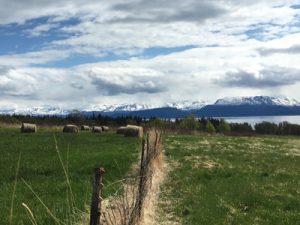
Alaska In Photos: America’s Arctic Agriculture
Alaska is huge, remote and still largely pristine. It’s 2.3 times the size of Texas, with a population of just 738,000 people and 175,000 moose. While small, the state’s ag industry is important. Ornamentals, aquaculture, potatoes and cattle are top crops, and home-based and small-scale production help improve food security. Here’s a little of what we saw and learned on a recent visit.
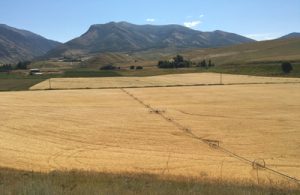
Utah in Photos: Managing Pests in a Unique State
Utah is one of the most urbanized states in the nation, with 90 percent of the population living on just 1.1 percent of the land. It’s also the second driest state, averaging less than 10 inches of rainfall a year, and has alkaline soils with low organic matter. It’s a challenging environment to farm in. Keeping invasive pests out of Utah – and minimizing the damage they cause once they arrive – is a major focus.

New Mexico in Photos: Loving the Land of Enchantment
In New Mexico, the chile pepper is king. Hay is grown on 40 times the acreage and pecans rack up nearly 4.5 times the farm sales, but you don’t see either of those crops on the “Welcome to New Mexico” signs as you drive into the state. You see red and green chile peppers. Chile isn’t a crop, it’s culture. Like Florida citrus and Idaho potatoes, New Mexico’s identity is tied to a crop.

Montana in Photos: Defending the Last Best Place
The state that calls itself “The Last Best Place” has a lot to protect from pests: vast fields of wheat and barley driving its agriculture sector, miles of mountains, forests and rangeland forming an outdoor paradise, and clear rivers and lakes at the upper end of the North American watershed. Here’s a look.

VIDEO: Teaching IPM through the Diagnostic Lab at Montana State
Every sample that comes to the Schutter Diagnostic Lab at Montana State University is an opportunity to teach someone else about integrated pest management.

VIDEO: Where to Get Good Gardening Advice
In this video, Ariel Agenbroad from University of Idaho offers great tips for home gardeners about where to get good pest-management advice.

VIDEO: Why Growers Embrace Salmon-Safe Farming
In growing numbers, farmers in the Walla Walla Valley are embracing salmon-safe farming practices to better manage their land, benefit local rivers – and get higher prices for their products.

VIDEO: Urban Farm Pest Pressures and Solutions
Learn about the pest pressures faced by urban farmers — and how integrated pest management provides economical solutions — with Ariel Agenbroad, Local Food & Farms Advisor with University of Idaho Extension.
VIDEO: Safflower Makes an Areawide IPM Program Work
In Kings County, California, safflower is an important rotational crop that improves the soil health and makes farming more productive. It’s also the key to an areawide IPM program that manages pests and reduces pesticide sprays.

VIDEO: Training Ag Professionals in IPM
A multi-state program in the Columbia River Basin is improving agricultural practices by training young ag professionals in integrated pest management.

VIDEO: Planting Flower Strips for Native Bees
Montana State University researchers discuss flower strips of nine native plants that provide habitat for native bees and an additional income source for farmers who can collect and sell the flower seeds.
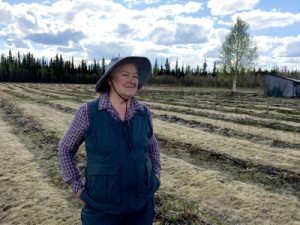
A Home-Grown Industry: Alaskan Peonies Fills a Global Gap
Not very long ago, if you were planning a summer wedding or special occasion, one flower you could not get at any price was a peony. The elegant, lacy blooms simply weren’t available. Alaska changed all that.

Are Birds an Economic Pest on Northwest Dairies? New Research Aims to Find Out
That birds can be a pest for fruit growers is no surprise. But what about to cows? Are birds a pest on dairies? Do they bother the milk cows? And do they cause economic losses? Researchers in Washington state are trying to find out.

Hill-Climbing Cows May Bring Big Benefits to Western Rangeland and Ranchers
Conventional wisdom says cows don’t go up steep slopes. They don’t climb hills and don’t travel very far from water. But some cows never got that memo, and researchers are looking into whether naturally hill-climbing cows can provide production and environmental benefits in the rugged West.

Idaho Researchers Embrace Collaboration
Anyone who complains about university research being too theoretical or Ivory Tower hasn’t visited the University of Idaho Aberdeen Research and Extension Center. There, multi-disciplinary teams regularly work together on complex investigations into pests of the state’s important crops like potatoes, wheat and barley.
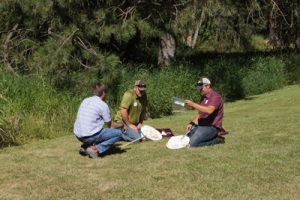
IPM Training Program Targets Young Ag Professionals in the Pacific Northwest
Identification of pests and beneficials is one of the first principles of integrated pest management, and the core of a train-the-trainers program that’s been successfully improving the skills of young ag professionals in rural Oregon, Washington and Idaho since 2009.
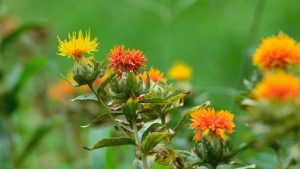
Safflower Makes an Areawide IPM Program Work
Safflower, a low-value oil seed crop, is the key to an incredibly successful soil health and areawide integrated pest management program in California — and a great illustration of how IPM works.
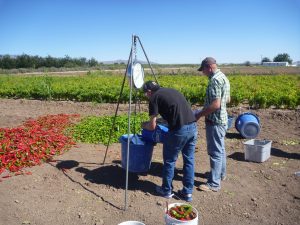
Can an Economic Model Show Growers the Importance of Reducing the Weed Seed Bank?
How important is it to keep weed seeds out of vegetable fields? Mexico State University’s Brian Schutte recently looked at that very question. Funded by the Western IPM Center, Schutte studied one particular weed, tall morning glory, in Southwest chile pepper fields, and developed an economic model growers can use to see for themselves how managing the weed seed bank can help their operations.

Grazing Guidelines for Noxious Weed Control
Researchers, ranchers, and land managers know that livestock grazing can be a valuable and selective noxious-weed management tool, and this guide summarizes all the effective techniques.
IPM Adoption is Widespread in the West
Many integrated pest management practices are so widely adopted in Western agriculture they have become conventional pest management. That is one of the key findings of a new report by the Western Integrated Pest Management Center titled Adoption and Impacts of Integrated Pest Management in Agriculture in the Western United States.

Identify Herbicide Damage to Crops and Ornamental Plants
Identifying nontarget crop and ornamental plant damage from herbicides has become much easier, with the launch of a new online photo repository by the University of California Statewide IPM Program.
Small Farms IPM Group Finds Invaders, Opportunities and Challenges
Bringing IPM information to small-scale farmers is a significant challenge, but one that has many potential benefits – including expanded opportunities to spot invasive pests and diseases.
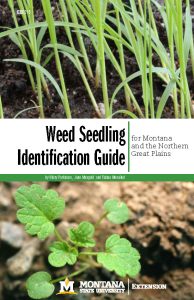
Montana Develops Weed Seedling Guide for the Northern Great Plains
Rapid and accurate identification of weeds at the seedling stage can save producers and land managers time and money but most weed identification guides only provide information about the mature stage of the plants. Not this one.

New Guide Helps Land Managers Control Medusahead
As an ecosystem-transformer species, medusahead is among the worst weeds. Not only does it compete for resources with more desirable species, but it changes ecosystem function to favor its own survival at the expense of the entire ecosystem.
Center-Funded Website Helps Vets Treat Animals for Fleas, Ticks and Other Pests
Whether it’s cattle with face flies or a dog with ticks, vets throughout the West can now easily find the available treatment options in their state thanks to a new website built with Western IPM Center funding.
Boosting Invasive Species Cooperation Using Zebra Chip as a Model
When an invasive species is first detected in an area, the initial response is critical. Like with a cancer, the correct early detection and response can make a big difference in controlling the spread and severity of the outbreak.

Center Funding Helps Develop a Better Way to Control Prionus Beetles
Hop growers in the Northwest – as well as a sweet cherry, apple and other fruit growers around the nation – now have a new mating disruption tool to combat the Prionus beetle and its root-boring larvae, thanks to research funded in part by the Western IPM Center.

Death From Above: Encouraging Natural Predators
Native predators like kestrels and barn owls can play a valuable role in controlling pests not only on farms, but also in parks, golf courses and large yards and gardens. While they rarely eliminate a pest problem, they can reduce the need for pesticide use and other pest-control measures.
Helping Native Bees and Other Pollinators Thrive in New Mexico
Gardeners, growers, land managers, school groundskeepers and others in New Mexico now have a few new ways to help honeybees and native wild bees thrive.
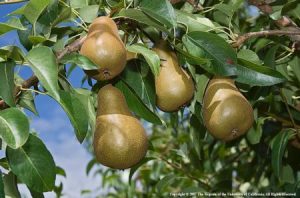
Pest Management Strategic Plan Leads to Quick Action for Northwest Pears
Controlling pear psylla while also preserving pollinators and other beneficial insects emerged as the key pest-management challenges for growers in Washington and Oregon – and directly led to a “Psylla Summit” to address the challenge.

Pesticide Safety Training for Hawaii’s Farm Sector
Farmworker safety training often comes with language challenges – but few places more so than Hawaii, where the College of Tropical Agriculture and Human Resources at the University of Hawaii recently produced two pesticide-safety training charts in English, Mandarin, Tagalog and Thai.
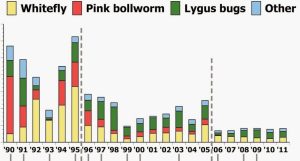
Spray Reductions in Cotton
For the past 15 years, researchers have been tracking pesticide use on cotton fields in the Southwest, and the reductions they’ve documented have been nothing short of remarkable.

Progress against Onion Pests
An update to the Pest Management Strategic Plan for dry bulb storage onions shows progress against thrips and Iris yellow spot virus, but still challenges to overcome.