
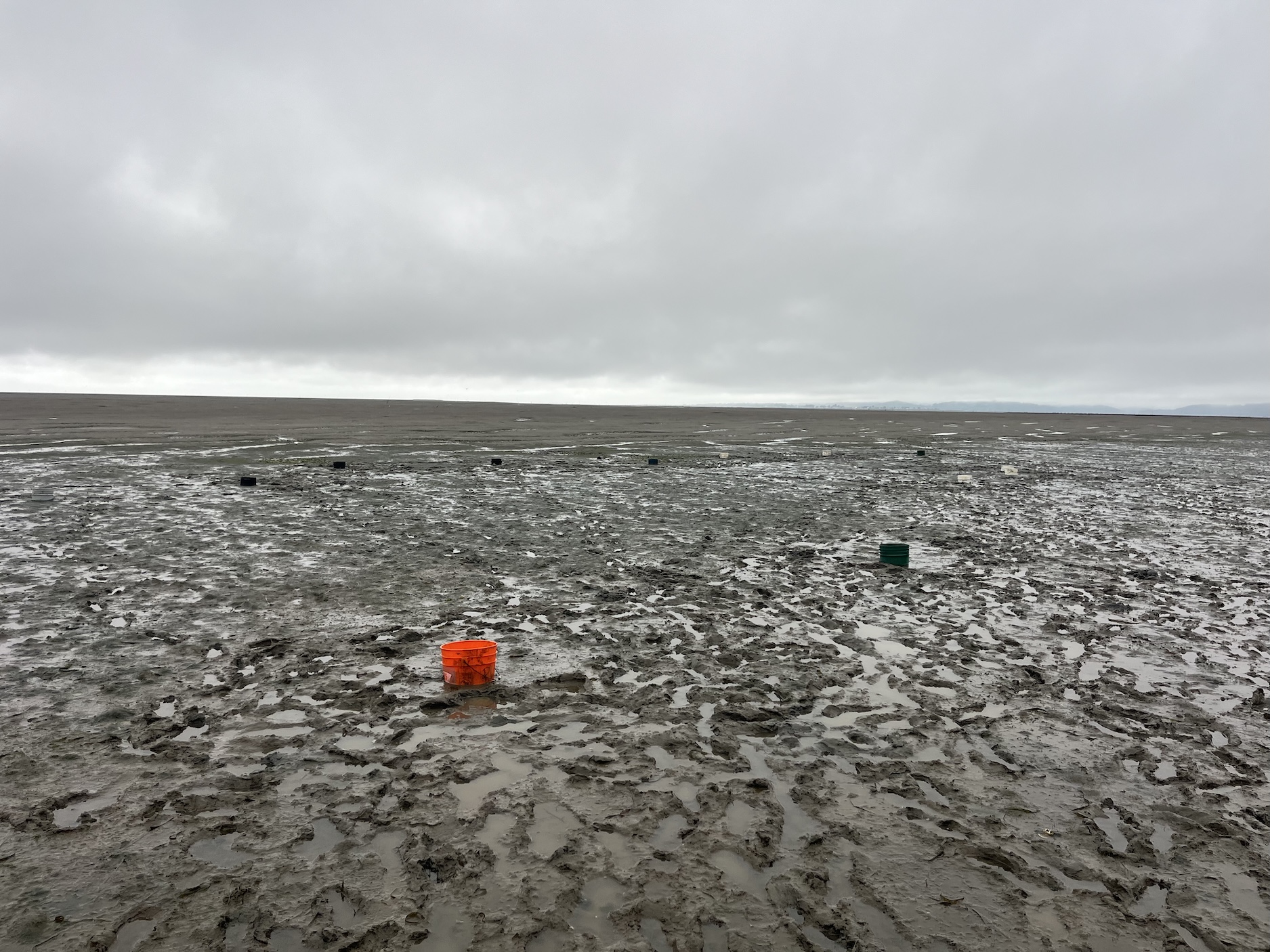
For the past century, a silent war has waged in the tidal mudflats of Washington’s Willapa Bay. The combatants: native burrowing shrimp versus farmed Pacific oysters.
Right now, the shrimp have the upper hand, but the oysters’ allies have been testing new weapons, hoping to turn the tide. One of those weapons? Sodium bicarbonate – the baking soda sitting on an upper shelf in many kitchen cupboards.
Emma Guerrini Romano, a doctoral student at the University of Washington, is a new recruit to the battle – on the oysters’ side.
“Willapa Bay produces about a fourth of the oysters produced in the United States,” she explained. “It’s a very large industry, primarily for canned and jarred oysters.”
Oyster farmers have traditionally seeded the mudflats with baby oysters, or spat, letting them grow and mature in the mud and harvesting them when they reach market size. There are alternatives to this “bottom-culture” growing system – securing oysters in bags attached to long lines or bags floating on the tides – but they require large investments beyond the means of many of the bay’s smaller producers.
The burrowing shrimp were first described as pests in the scientific literature in the 1920s, killing oysters essentially by accident.
“The way the shrimp kill oysters is through their burrowing behavior,” Guerrini Romano explained. “They are really, really effective burrowers, and just one shrimp can displace 20 to 50 milliliters of sand a day. And they can grow in densities of up to 500 shrimp per square meter.”
That many shrimp kicking up that much sediment buries growing oysters in the mud, causing them to suffocate and die.
Growers used to put down gravel to discourage the shrimp, and then for many years sprayed the mudflats with a broad-spectrum insecticide to kill the shrimp. It worked, but consumer pressure and regulatory changes ended the practice about 10 years ago.
“Since then, oyster farmers have been losing a massive amount of their land to this pest,” Guerrini Romano said. “The shrimp are completely uncontrolled. They go where they want and their movements are unpredictable.”
But they also live in deep burrows that contain little oxygen, high concentrations of sulfides and high accumulations of waste products. In short, it’s a difficult environment to live in, and University of Washington scientists funded by the state’s Integrated Pest Management working group hypothesized that by making the conditions ever so slightly more difficult – changing the pH of the water in the burrow perhaps – that the burrow could become fatal to the shrimp.
“That’s where the idea was born to use baking soda,” Guerrini Romano explained. “Baking soda makes water more basic, shifting the pH higher, which can convert non-toxic ammonium to its toxic form of ammonia.”
The initial lab experiments were a resounding success.
“We put a bunch of baking soda in the water of burrowing shrimp and they die,” she said.
A couple of problems. Guerrini Romano is a physiologist, and when she looked at the biological responses of the shrimp to the baking soda she found it wasn’t the change in pH that killed them, but an imbalance of chloride. (The baking soda adds a bunch of sodium and carbonate to their environment but little chloride and that lack is fatal to the shrimp.)
And even though it meant the initial hypothesis was wrong, baking soda still killed the shrimp. Guerrini Romano got a Western SARE Graduate Student grant to scale up the research and begin field trials. That’s when the bigger problems surfaced.
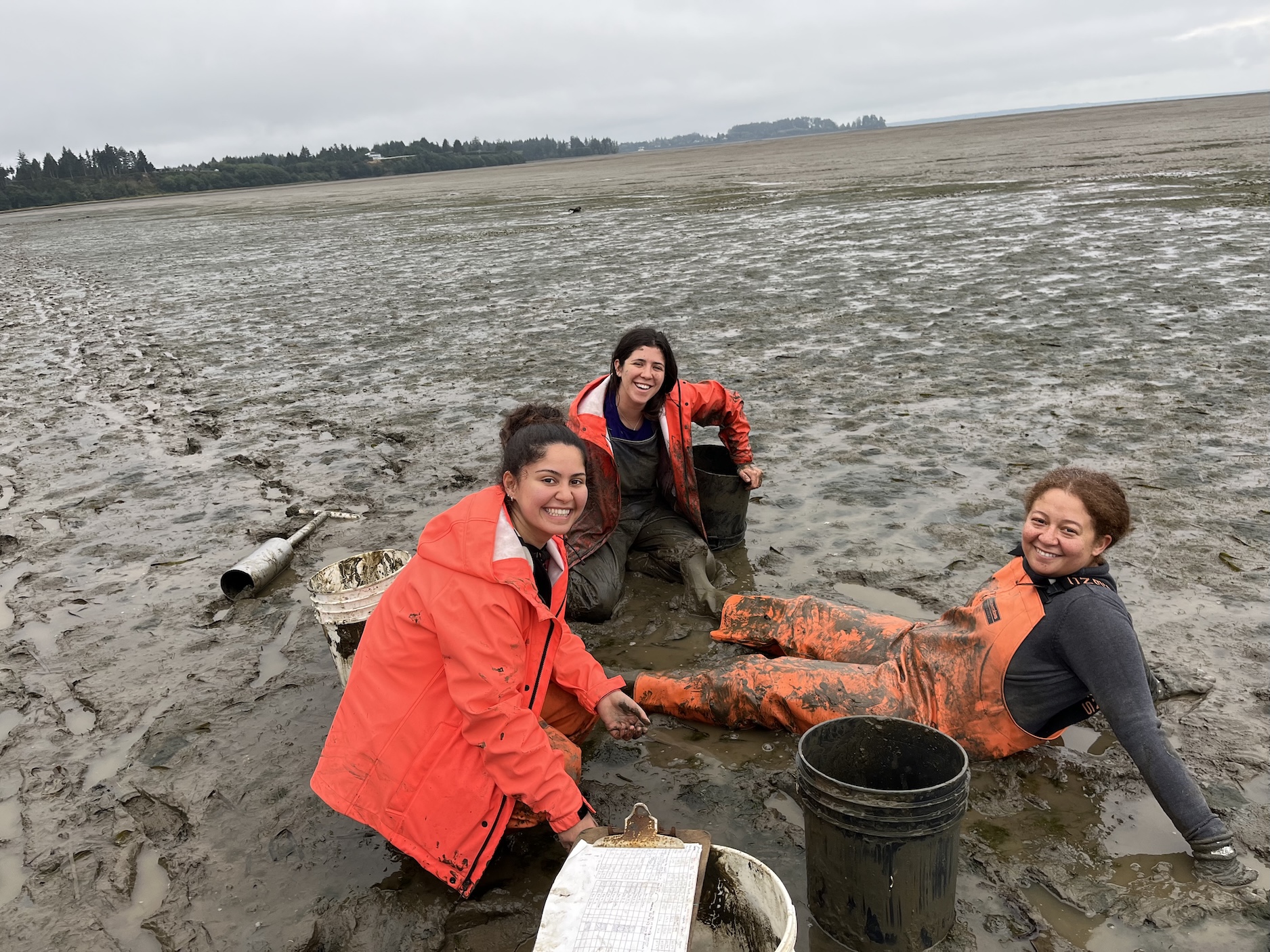
“The big one was the concentration of baking soda required,” she said. “When we were doing the application in the lab, we were using 70 grams of baking soda per liter of seawater. If you scale that up to the amount of land that farmers have, it’s thousands of pounds of baking soda per acre – we would literally wipe out the entire supply of baking soda in Washington. That would be costly and inefficient.”
For her field trials, she tested smaller-scale applications, putting baking soda in five-gallon buckets set on top of shrimp burrows, letting tidal action and the density of baking soda sink the solution to naturally replace the seawater in the burrows.
“Our results are preliminary and we will repeat trials this upcoming spring and summer, but we found fewer shrimp beneath the buckets with baking soda,” Guerrini Romano said. “It might by that the shrimp were sensing the baking soda in their burrows and leaving. Or it might be that the design is flawed. The repeated trials in 2026 will help determine which.”
If the shrimp are indeed fleeing the baking soda, it means the chemical – or one like it – can potentially be used as a deterrent.
“Can we take the response created with baking soda that kill burrowing shrimp and mimic them with some other salt or chemical?” she said. “Can we create a chemical application method that gets directly into the burrows? Most importantly, could farmers use this method?”
Mechanical control is also being tested in the bay by University of Washington scientists Dr. Jennifer Ruseink, Guerrini Romano’s advisor, and Dr. Alan Trimble. Two approaches, compaction and vibration, collapse the burrows and entomb the shrimp. Vibration works – the shrimp can’t burrow out fast enough to escape – but cost and scalability are potential issues.
“There is research on biological controls using microbes headed by the Invasive Species Corporation, mechanical controls by Drs. Ruesink and Trimble, and the chemical control research I’m doing that leverages the shrimps’ physiological weak points,” Guerrini Romano said. “It’s a bit of a giant ball game.”
There’s a term for that ball game, of course: integrated pest management.