

Just like the early bird gets the worm, early detection is often what gets the weed. Catching weeds in earlier life stages means they’re more susceptible to herbicides, and treating a patch of weeds before it spreads into a larger area can stop a major problem before it starts.
Hairy willow-herb makes all this very difficult.
In Colorado, this invasive weed tends to colonize large natural wetlands, which are tough for humans and ground vehicles to navigate. And other vegetation in the wetland, like cattails and Canada thistle, can hide young hairy willow-herb plants.
By the time it’s easily visible, herbicides aren’t very effective because the plants are too large. And when left unmanaged, the hairy willow-herb becomes obvious, creating dense stands and outcompeting other wetland plants.
Jake Courkamp, a rangeland weed ecologist at Colorado State University, and his collaborators were given an unexpected opportunity to research this weed when their county reported an infestation on one of the university’s research properties. Tony Vorster and Nick Young, researchers at Colorado State University’s Natural Resource Ecology Laboratory, and Courkamp used the lab’s drone, officially called an unmanned aerial system, to take pictures of the mature hairy willow-herb at the infested site.
“In the pictures, it looked like a hedgerow,” Courkamp said. “Like it could hold you up if you jumped into it.”
That visibility led to a project funded by the Western IPM Center testing how drone imagery can improve detection of this weed in Colorado wetlands.
Humans, Drones and Automated Classification
The team is collecting imagery data from their research sites three times: early summer when the weed is small, and mid-summer and early fall when plants are clearly visible. This will give the most variation in the life stages of both hairy willow-herb and the surrounding vegetation, with the goal of finding when they are easiest to tell apart.
In the images from their early summer drone flight, the young hairy willow-herb plants were a slightly lighter shade of green but otherwise looked very similar to the other vegetation. But getting on-the-ground data later in the season will help find the hairy willow-herb even in these earlier photos.
“We’ll walk transects through the wetland sites and delineate polygons of different vegetation types, and then those polygons will be cross-referenced with the imagery collected from the drones,” Courkamp said. “That way we’ll be able to see if there are key characteristics that we can pull out of the imagery at early, middle, and late points in the season.”
For finding hairy willow-herb in the pictures, the team is testing machine learning and other classification methods along with visual inspection by the researchers. The team will set some photos aside as training data, marking what is and isn’t hairy willow-herb based on the polygons of vegetation from the on-the-ground surveys. These classification tools can then use that data to distinguish between the weed and other vegetation in new imagery.
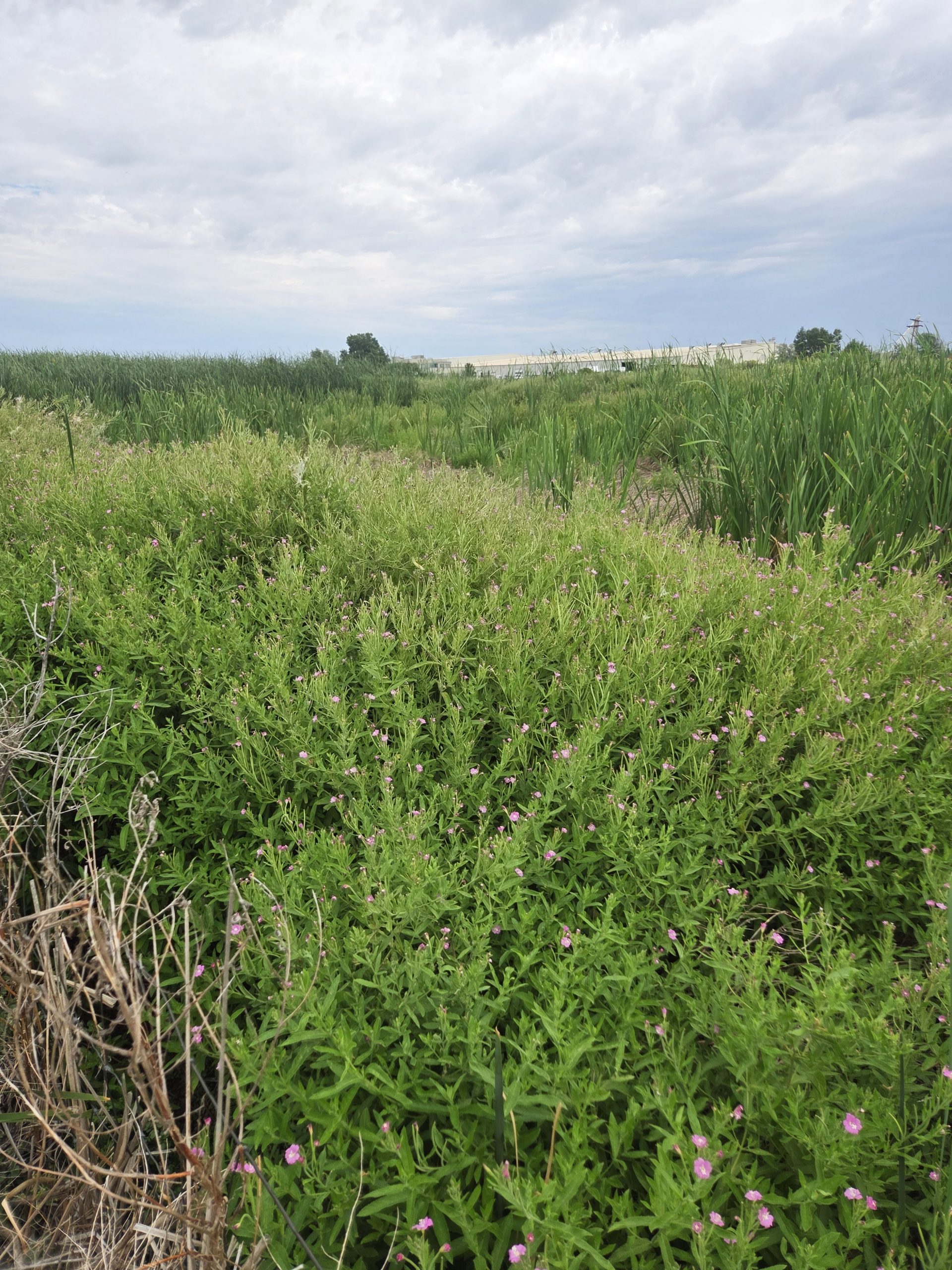
According to Courkamp, the ideal scenario would be an expedited detection and treatment system: a drone could survey wetlands, a classification tool could mark areas with hairy willow-herb, and a spray drone could apply herbicide to those areas when the plants are young.
“If we can detect it earlier in the season, we could treat it early enough that it would speed up the control timeline,” Courkamp said. “So instead of needing two to four years of herbicide application, maybe we could knock it down to one or two.”
Using drones does not work in all situations, partly because the battery life and storage space for photos on a remote sensing drone, and the spray tank on a spray drone, can be too small for a large infestation. But for the specific situation of a hard-to-navigate wetland and a hard-to-find weed, it seems like a good fit.