
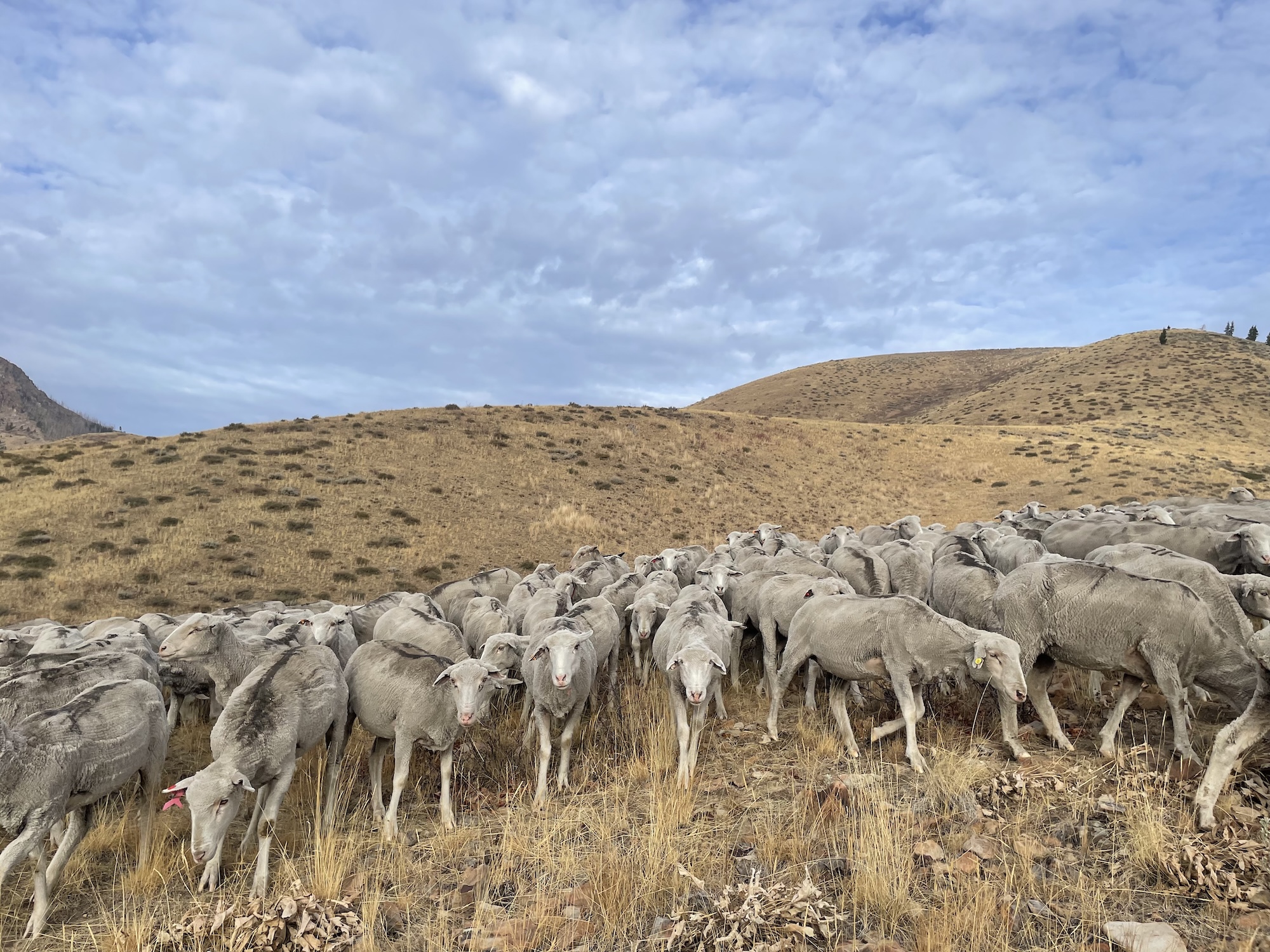
Targeted grazing – using livestock to intentionally manage vegetation – can excel at treating large patches of edible invasive plants and can also create fuel breaks to reduce wildfire risk.
So why don’t U.S. Forest Service staff use it more often to manage national forests?
That’s the question Briana Swette, a postdoctoral fellow working with Dr. Kelly Hopping at Boise State University, wanted to answer.
A large portion of federal lands already have grazing animals on them and livestock can be more cost-effective than herbicides in certain circumstances, like managing large cheatgrass infestations.
“It’s a tool in the toolbox that can fill its own niche,” Swette said.
With a Western IPM Center grant, Swette interviewed Forest Service staff working in national forests in Washington, Oregon, Nevada, Utah, Idaho and Wyoming. She aimed to learn their attitudes on targeted grazing and any major barriers to using it in the forests, including social and institutional ones.
Overall, while forest staff thought positively of targeted grazing, they were less willing to put it into practice in their management areas. One reason was that participants were simply unsure how to put the theory of targeted grazing into practice in their specific management areas.
But their biggest barrier?
“It wasn’t a funding constraint or a policy constraint, but more just they hadn’t considered it,” Swette said. “There were no norms around using the tool. Their bosses weren’t talking about it. Nobody was coming to them with ideas. There just wasn’t a lot of conversation about targeted grazing.”
But, Swette learned, staff that knew someone else doing targeted grazing, even if it was in a different system, were more likely to consider using it themselves. In fact, some interview participants said they may propose targeted grazing to their team now that they were exposed to the idea through the interview process.
Responding to Barriers
With the knowledge gained from the interviews, Swette is now working to put targeted grazing on Forest Service staff’s minds.
One project in partnership with the Forest Service and funded by Western SARE involves building an online, interactive map to show where targeted grazing has been used in national forests – because projects have happened.
“We found more than 100 projects, many different models, many different animals, in different contexts for many years,” Swette said. “So there was more going on than people knew about.”
The map will include projects that did not work or that were too expensive to continue because it’s just as important to know when targeted grazing isn’t a feasible solution, Swette said.
Another portion of her research, funded by a USDA National Institute of Food and Agriculture Postdoctoral Fellowship Grant, will create context-specific targeted grazing strategies that can help guide managers to use the tool – for example, land with high invasive grass presence in an area with supportive graziers. The idea is that Forest Service staff could easily see what types of targeted grazing strategies could work in the places where they manage and then develop solutions specific for their national forests and communities.
One Tool of Many
Though targeted grazing is a beneficial tool, it comes with its own considerations.
The logistics of targeted grazing can be complicated for the ranchers that the Forest Service works with. The targeted plants need to be in a palatable stage of growth, which may not match the timing of their grazing permits. It may be difficult to transport the livestock or have water available for them depending on the location of the site. And the cost of labor for herders can make any additional grazing time uneconomical. On the Forest Service staff’s side, not all kinds of land are suitable for this practice.
Swette knows that targeted grazing is like any other IPM tactic. It’s more useful in some cases, less useful in others and meant to be one practice of many to manage unwanted vegetation.
“We’re not trying to advocate targeted grazing,” Swette said, “It’s just that it’s underutilized compared to what the data say it could do.”